
Pourquoi les collecteurs solaires à tubes sous vide sont-ils parmi les plus efficaces dans les climats nordiques ?
Why Evacuated Tubes or Vacuum Tube Solar Collectors are among the most efficient in Nordic Climates?
Most Canadian Cities and Businesses are located in Nordic Extremely Cold Climate areas. Living in such a harsh climate requires significant resources to provide space heating as well as domestic hot water heating for buildings. This blog will explains why Vacuum Tube Solar Panels are the best choice to provide free heating and fight climate change.
Introduction
Space heating and domestic hot water heating represent between 66 to 75% of residential utility bill for a typical Canadian home. Except for Vancouver area, Most Canadian Homes and Businesses are not livable without proper space heating. Finding a reliable, efficient (why not free) and affordable way for heating Buildings is becoming a necessity with climate change, increasing conventional energy prices and more demanding building codes.
Covid-19 Pandemic exposed the risks associated to globalization and global connectivity. The speed the virus has spread across Canada and the US disrupted the flow of goods and services between countries. This disruption of the global supply chain, impacted the life of every person in North America and created a movement of self sustainability and independence from any future disruption of global supply chain. Canadian Building Code will require that, after 2025, every new house in Canada be Net Zero ready. By 2030, every new house in Canada will have to be Net Zero.
This means that, in the near future, every household will have to be ready to produce (in part or in total) his own energy (solar, wind, geothermal, etc...) and food (vegetables, fruits, etc...) locally in order to survive in the pre-Covid-19 era.
Why Solar Thermal not Solar Photovoltaic? Why Solar Water Heating and not Solar Air Heating?
Photovoltaic (PV) Solar Panels Technology is great for providing free electricity for plug loads, lighting as well as electricity for fridges and other appliances. However using PV Panels in Canada have lower annual energy efficiency when compared to other solar technologies (such as Vacuum Tube Solar Collectors). In most Canadian installation PV Panels are installed at a Tilt Angle of 30 degree from the horizontal. This leaves them covered with snow almost 4 months a year which limits their annual energy efficiency to like 15-17%.
Compared to PV Panels, Vacuum Tubes Solar Collectors have 2 to 3 times the annual efficiency of PV panels, requiring 2 to 3 times less roof space. Also Vacuum Tube Collectors have empty space between tubes and are installed at a steeper tilt angle (45 to 70 degree). This makes snow less likely to accumulate on them, which increases their heat output in winter (When Heat is needed the most).
Solar Air Heating is also a promising Technology. In Residential and Light Commercial Applications where space heating is forced air, Hot Air is only required in winter, which leaves the solar air heating panels useless in summer time. Compared to Solar Hydronic Heating, Hot water demand is 12 month a year and 24 hours a day. In winter, Hot Water is required for Domestic Hot Water Heating and/or Space Heating and in summer for Pool/SPA Heating as well as Domestic Hot Water Heating (there are other advantages of using hydronic heating versus forced air heating, This Blog details them all)
By excluding the unused heat generated by solar air heating panels, will make Vacuum Tube Solar Collectors the most promising way of generating hydronic heat for our Canadian Climate.
Solar Water Heating Solar Collectors Ratings
Measuring Solar Collector's thermal efficiency is a complicated and expensive task. This why the Solar Rating and Certification Corporation (SRCC) and the Canadian Standard Association (CSA-F378) have accredited various labs in the US and Canada to provide more accurate, consistent and standardized efficiency values.
What defines collector's thermal efficiency and thermal energy outputs are the following factors:
Ti : Collector's entering fluid temperature in ⁰F or ⁰C.
Ta : Ambient Dry Bulb temperature in ⁰F or ⁰C.
I or G: Insolation Rate expressed in Watts/m² or Btu/hr.ft².
Type of Collector: Flat Plate (Glazed and unglazed), Evacuated Tubes, etc...
Collectors' thermal efficiency (Which is no more than the ratio of thermal energy output divided by solar insolation) is then drawn as function of (Ti - Ta)/I (or G)
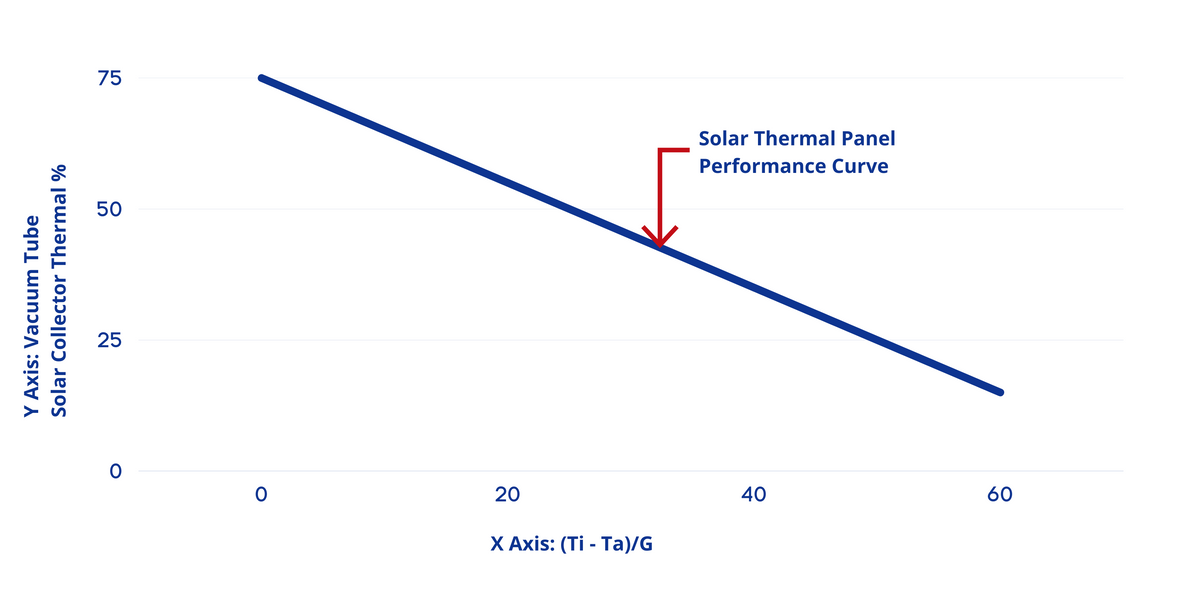
As we can see in the above Graph:
Solar Collector's thermal performance decreases when Ti (entering fluid temperature) is higher and/or Ta (ambient temperature) is lower.
Solar Collector's thermal performance increases when Ti (entering fluid temperature) is lower and/or Ta (ambient temperature) is higher.
So in hotter climates, where (Ti-Ta) is low, the best performing collectors are the one with a steeper inclined performance curves and in colder climates (such as in Canada and North of the United States) the best performing collectors are the one with a flatter performance curve.
HOW DO VARIOUS HYDRONIC SOLAR COLLECTORS PERFORM?

The blue Line reflects unglazed solar panel performance. They offer the steepest (Highest Y intercept value) curve, meaning they perform very well the entering fluid temperature is low and ambient air temperature is high (warm air). The steep slope shows that decreasing air temperature (or increasing entering fluid temperature) take a big toll on performance. This type of solar collector is great for heating pools in the summer because pool temperatures are usually fairly close to daytime air temperatures in the summer when pool use occurs (Ti-Ta is at its minimum, and efficiency is at its max).
The red line reflects glazed flat plate solar panel performance. They offer slightly lower Y intercept values because the glass coating reflects some light, but the efficiency slope is flatter than unglazed panels because the glazed panels have insulation inside and trap the absorber's heat inside the collector's box. as a result the panel looses less heat when outdoor air is cooler.
The green lines represent evacuated tube performance. These collectors offer lower Y intercept values and their slope is even flatter that glazed panels. On sunny hot days, they don't perform as well as flat plates, but the excellent vacuum insulation makes them more efficient that flat plates when it's very cold outside or sun is weak (low insolation values). This flatter slope also means that evacuated tubes are more appropriate for projects requiring high fluid temperatures in colder climates such as space and process water heating.

Further Readings:
- How do Vacuum Tubes Solar Collectors Work?
- How do Hydronic Solar Thermal Heating Works?
- Decarbonization by Producing Medium Temperature Hot Water with Vacuum Tube Solar Collectors
- How to install a Solar Panel on an inclined roof?
- How to lengthen the lifespan of Vertical Geothermal Well with Evacuated Tube Solar Collectors in Nordic Climates?
WHAT IS THE USEFUL COLLECTOR'S THERMAL EFFICIENCY?
Having free hot water from your solar panels is fun but to payback your investment (the cost of panels, storage tank, piping, control, etc...) you need to make use of the generated heat. Living in Canada or the Northerm part of the US and having a lot of hot water in July and August in excess of your domestic hot water demand is simply a waste.A solar generated unused heat, is a wasted heat that don't count in your installation annual efficiency and savings, because that wasted heat do not offset any KWh from your utility bill.
The intersection between the Green and Red performance line in Fig.2 is at (Ti-Ta)/G=0.4. Assuming we are in Montreal (Quebec) where:
Outdoor temperature is at -30⁰ C and our Solar Panels are used for space heating where the heating loop is heated from 104 ⁰F (Ti=104 ⁰F=40⁰C) to 120 ⁰F. In half sunny half cloudy day with G=500 W/m². = 158 Btu/hr.ft² (Ti-Ta)/G= (104+20)/158=0.78 way on the right of the intersection point. This gives us a thermal efficiency of 0.35 or 35% for vacuum tube collectors versus a 0.1 or 10% efficiency for glazed flat plate collector.
Outdoor temperature is at 0⁰C and our Solar Panels are used for space heating where the heating loop is heated from 104 ⁰F (Ti=104 ⁰F=40⁰C) to 120 ⁰F. In half sunny half cloudy day with G=500 W/m². = 158 Btu/hr.ft² (Ti-Ta)/G= (104-32)/158=0.45 way on the right of the intersection point. This gives us a thermal efficiency of 0.4 or 40% for both types of collectors.
For outdoor temperatures above 0⁰ C, Flat Plate solar collectors are more efficient but heating demand is much lower than in extreme winter conditions. Higher Thermal efficiency at mid-winter season generate more energy than needed, thus increasing the volume of wasted energy.
In the city of Montreal we have 121 110 Heating Hours for outdoor temperatures below 0⁰ C (where heating demand is high to medium) and 54 385 Heating Hours for outdoor temperatures above 0⁰ C (where heating demand is moderate to low).
Running Polysun Solar simulation and comparing our HydroSol VT58 Vacuum Tubes Solar Collectors (2 x 30 Tubes Collectors) to a Glazed Flat Plate solar collectors (having a Y intercept of 0.792, slope of -7.517 W/m².⁰C and same Gross Area) and after putting the monthly Generated KWh and the Building Monthly Heating Demand into a graph, we get the following result:

As we can see in the above graph:
- Between the months of May and September, Glazed Flat Plate Collectors generate much more energy than Vacuum tubes Collectors, exceeding Building Hot Water demand. Generated Hot Water in Excess of demand is not counted toward annual Collectors' thermal efficiency.
- Between the months of October and end of April, Glazed Flat Plate Collectors generate much less energy than Vacuum tubes Collectors in a scale far below Building Hot Water demand.

Because Vacuum Tube Solar Collectors energy production is more aligned with demand presence, they do cover a larger % of montly and annual heating demand. This means that in this case Vacuum Tubes Solar Collectors are (91.3 - 66.8)=24.5% more efficient than Glazed Flat Plate.
What would it cost to put in a heating system for my 24 X 28 two story garage? I live in southwestern Ontario.